Transitions
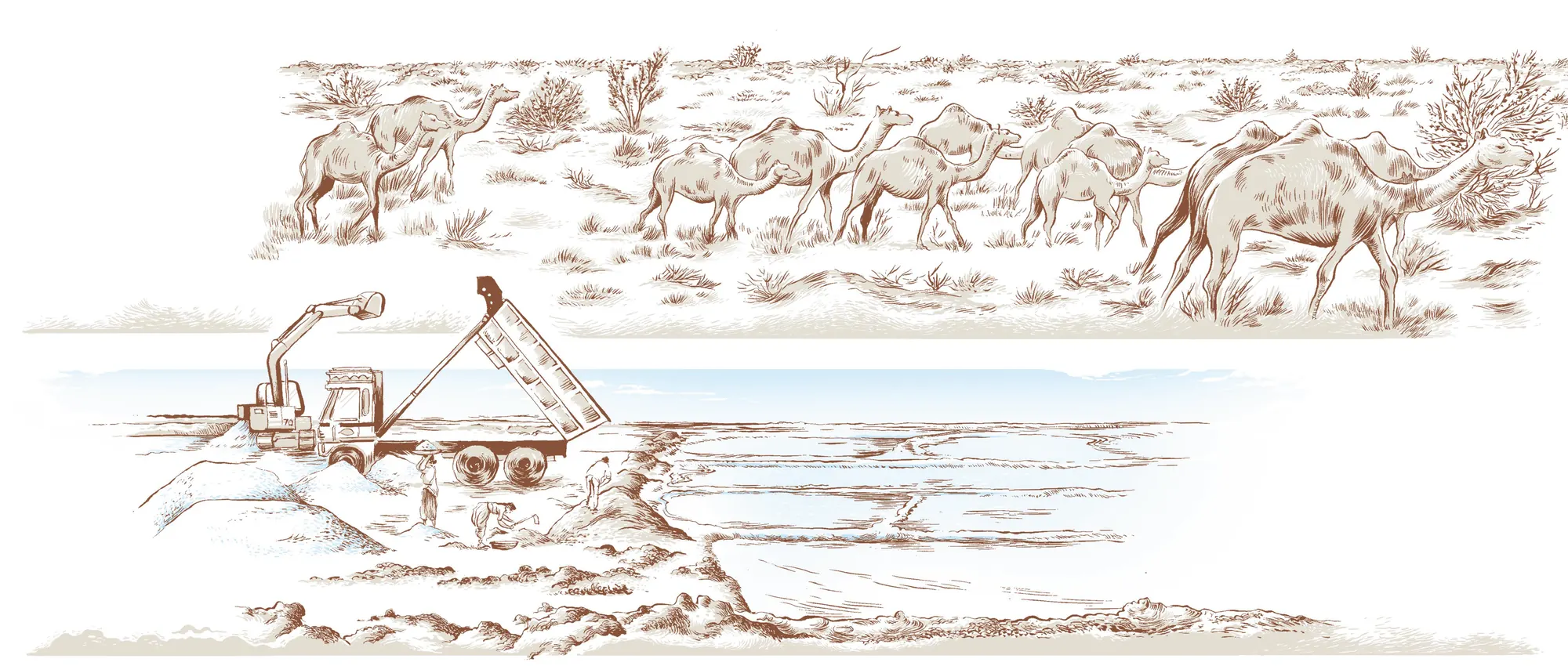
Illustrations by Somesh Kumar, from World on the Roof.
Transitions
For well over a hundred years, the state has expected pastoralists to settle. From the perspective of social evolution, pastoralism has often been portrayed as a stage between hunter-gatherer and cultivating societies. Within this framework, attempts to settle pastoralists could be presented as a form of social progress or even a civilising mission. And yet pastoralism has persisted, often in the face of remarkable odds. This persistence should not be mistaken for stagnation. Pastoralism is not a static or unidimensional form of animal husbandry; it is continually evolving in response to market signals, labour availability, new opportunities and emerging constraints, as well as changes in the landscapes through which pastoralists move. As with any livelihood system, pastoralist management of animals changes over time. Communities may shift the breeds they keep, alter their routes and patterns of movement, change herd sizes, take up new forms of employment, or modify the products they sell. These changes are not necessarily a departure from pastoralism. They are often ways of adapting pastoral livelihoods to a changing world. This section examines the nature of these transitions among Indian pastoralists, and asks what they reveal about the changing form, and continuing resilience of pastoralism.
 Mountain Pastoral RegionArunachal PradeshComing soon
 Mountain Pastoral RegionHimachal PradeshComing soon
 Mountain Pastoral RegionLadakhComing soon